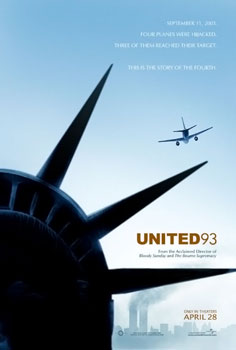
United 93 (film)
From Wikipedia, the free encyclopedia
Jump to: navigation, search
United 93
Directed by
Paul Greengrass
Produced by
Tim BevanEric FellnerPaul GreengrassLloyd Levin
Written by
Paul Greengrass
Music by
John Powell
Cinematography
Barry Ackroyd
Editing by
Clare DouglasRichard PearsonChristopher Rouse
Distributed by
Universal PicturesWorking Title
Release date(s)
April 28, 2006September 5, 2006 (DVD)
Running time
111 min.
Country
UK France United States
Language
EnglishArabic
Budget
$15,000,000
Gross revenue
$76,286,096
Official website • IMDb • Allmovie
Ratings
Germany
12
United Kingdom
15
United States
R
United 93 (formerly named Flight 93) is a 2006 film written and directed by Paul Greengrass that chronicles events aboard United Airlines Flight 93, which was hijacked during the September 11, 2001 attacks. The film attempts to recount with as much veracity as possible (there is a disclaimer that some imagination had to be used) and in real time (from the flight's takeoff), what has come to be known in the United States as an iconic moment of heroism. According to the filmmakers, the film was made with the full cooperation of all the families of the passengers.
United 93 premiered on April 26, 2006 at the Tribeca Film Festival in New York City, a festival founded to celebrate New York City as a major filmmaking center and to contribute towards the long-term recovery of lower Manhattan. Several family members of the passengers aboard the flight attended the premiere to show their support.
The film opened nationwide in North America on April 28, 2006. Ten percent of the gross from the three-day opening weekend was promised toward a donation to create a memorial for the victims of Flight 93. United 93 grossed $31.4 million in the United States, and $76.2 million worldwide.
Contents
1 Plot
2 Cast
3 Production notes
4 Historical background
5 Controversy
6 Critical reception
6.1 Top ten lists
7 Awards and nominations
7.1 Won
7.2 Nominated
8 DVD
9 See also
10 References
11 External links
Plot
The film opens early on the morning of September 11, 2001 with hijackers Ahmeds al-Nami and al-Haznawi praying in their hotel room, United 93's skyjacking ringleader Ziad Jarrah reading the Koran, and Saeed al-Ghamdi having a shave, then leaving for Newark International Airport. At the airport, the passengers and crew board United Airlines Flight 93 along with the hijackers. Shortly after boarding, Flight 93 runs into rush hour traffic, and the flight is momentarily delayed for 30 minutes. The other 3 would-be-hijacked flights take off.
Eventually Flight 93 does take off and passes by Manhattan. Captain Dahl makes a left bank and tells the forty-five passengers that while making the turn, those on the left side of the Boeing 757 have a clear view of Manhattan, especially of the Twin Towers. Hijacker Ziad Jarrah, who is sitting in seat 1B, catches a final glimpse of the World Trade Center as the plane climbs away.
Air traffic controllers monitoring all current flights notice that American Airlines Flight 11 has taken a southern turn toward New York City. Not long after that, Flight 11 descends into Lower Manhattan and crashes head on into the North Tower of the World Trade Center, though air traffic controllers are not aware of it. About 20 minutes earlier a tape recording was made of Mohamed Atta's infamous line "We have some planes, just stay quiet and you'll be okay. We are going back to the airport." Yet the controllers are not sure which airport the Boeing 767 will land. The content of the recording is reported to Ben Sliney. CNN then broadcasts the first international shot of the smoking WTC. While the traffic controllers, unaware that Flight 11 has crashed, try to make sense of it, United Airlines Flight 175 begins to descend and turn toward NYC as well. Air traffic controllers then realize they are dealing with a hijacking. American Airlines Flight 77 is also hijacked. The traffic controllers alert the U.S. Air Force, who debate whether or not to shoot down all suspected hijacked flights. The traffic controllers and Air Force then watch in horror as Flight 175 crashes into the South Tower of the WTC on live television, reported by CNN.
Soon, military personnel say that AA11 had not hit the North Tower, but was diverted to Dulles Airport.
Word of the planes that hit the World Trade Center reaches Flight 93, and the hijackers then decide to begin the hijacking. After Ahmed al-Haznawi assembles a bomb out of clay and plastic, the other 3 hijackers wrestle their way into the cockpit and overpower the pilots. In the cockpit they put a photo of the U.S. Capitol, their target, on the flight yoke mounted clipboard. By this time, Flight 77 crashes and creates a huge fireball at the Pentagon. The Mall in D.C. is also reported to be struck by another jet airliner.
Soon, those at the air traffic control tower in Cleveland suggest that Delta Air Lines Flight 1989 has also been hijacked, as Flight 93 heads closer towards the aircraft. Soon afterwards, Flight 1989 was taken off the list, and meanwhile Flight 93 soon turns towards D.C..
Much to the growing consternation of Ben Sliney and his people, coordination with the Air Force is haphazard and there are simply not enough planes ready, or armed, to respond to an in-air hijacking. Sliney ultimately decides to shut down all airspace in the United States and ground every single flight.
The hijackers do not prevent the people from making phone calls through the on-board GTE Airfone system. After hearing about the crashes into the WTC and the explosion at the Pentagon from loved ones, the passengers and crew understand that if they do nothing, they will also die, and eventually elect to storm the cockpit and attempt to retake the plane. The passengers make one last set of phone calls to friends and family, where they declare their intentions. The remaining crew assemble what makeshift weapons they can: cutlery, wine bottles, a fire extinguisher etc.
Learning that one of the passengers can fly a plane (although he has not flown a commercial aircraft), the group pin their hopes on him being able to at least control the plane. They debate whether the bomb is real or fake before deciding to start their counter-attack by overpowering al-Haznawi. He is killed by the passengers with a fire extinguisher. Having seen this, Ahmed al-Nami warns Jarrah and Saeed al-Ghamdi in the cockpit and makes several attempts to hold off the advancing passengers, including using what appears to be mace. He too is soon overwhelmed and killed by one of the passengers. Passenger Todd Beamer snatches the bomb from al-Haznawi's waist and announces the bomb was a fake.
Ziad Jarrah shakes the plane violently to throw the passengers off balance, but nonetheless they make it into the cockpit. al-Nami and Saeed al-Ghamdi are tackled to the floor and being overwhelmed by some other passengers. As the passengers wrestle with Jarrah for control, the plane goes into an angled nosedive towards the ground. The film ends with a shot of the plane crashing into a field through the view of the cockpit.

没有评论:
发表评论